Take a breath; reflect: why reflective practice is part of how we work at Unboxed
Vicky | Feb 2026
“I know reflection is an essential part of my job. But it’s still hard. Our reflection sessions at Unboxed are an incredibly useful way to do this. It’s a safe space, with dedicated time where it feels OK to pause. It’s a gentle process.” — Laura, Lead Designer
In fast-moving teams, where change is constant and delivery is key, moments to take a breath can feel rare. When there are competing priorities, it’s easy to push time for reflection to the bottom of the list. Or off the list altogether.
But it shouldn’t be that way.
Research consistently shows that reflective practice at work supports mental wellbeing and improves performance. Reflection is widely recognised as a core leadership skill and a key ingredient in learning, resilience, and long-term professional growth.
“I consider myself a reasonably reflective person but when you do it deliberately, with some structure and the guidance of a skilled listener, you really start to see the benefits.
Even when things can seem a little challenging, taking a moment to acknowledge that, recognise how you’ve coped, consider what you might do differently, or even just appreciate the support of those around you, it really helps.” — Martyn, Head of Product
When people take time to understand their own experiences, they make better decisions, build stronger relationships, and feel more fulfilled at work.
“Taking time to review the past month helps me realise how much I’ve actually achieved. Even when it feels like I haven’t done much, reflection shows me the progress I’ve made which is encouraging and motivating.” — Jean, Designer
How we build reflection into our work
At Unboxed, we know that good work comes from great people working together. Supporting our people means creating space to learn, grow and think. That’s why we’ve embedded a regular rhythm of reflection into how we work.
“Unboxed is the first place I’ve worked that offers monthly reflection sessions, and they’ve had a huge impact on my wellbeing and my professional growth.” — Kelsey, Marketing Manager
Monthly 1-2-1 reflection sessions
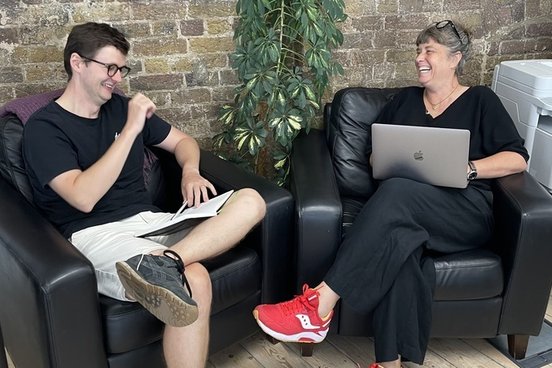
One way we do this is through monthly 1-2-1 reflection sessions, using a shared digital board to track thoughts and insights over time. These are gentle, guided conversations designed to help us pause and reflect on the past month.
We explore questions like:
What’s gone well, and why?
What’s been difficult?
What have we learned?
What have we enjoyed or found energising?
Are we on track with our goals?
Who have we appreciated, and what can we celebrate?
“I’ve found it especially helpful with the longer-term goals, because I think that’s the kind of thing (at least for me) that is easy to leave. It also helps that reflection is outside of the day-to-day teamwork because then it’s more neutral ground. And it’s not the same as a 1-2-1 with a line manager.” — Ben, Developer
Importantly, while reflections help us stay accountable, they are not part of a formal performance review process.
Reflection is about tuning in to how we’re really doing — both professionally and personally. It’s about looking at our experiences without judgement, but through a thoughtful and critical lens. It’s an intentional process that allows time to notice, appreciate and recalibrate.
“As a designer, I do a lot of active listening and critical thinking. While I love this part of the job, it can be exhausting. Reflection sessions flip my role. Someone else actively listens and guides me through my own reflections, helping me work out what I’ve valued and what I’ve learnt, in a way that takes the burden of ‘hard thinking’ away.” — Laura, Lead Designer
Reflection doesn’t always come naturally. It takes courage to look inward, and it can be uncomfortable. But the more we practise, the better we get at spotting patterns in how we work, where we thrive, and what we need to do our best work.
“Regular reflection helps to reveal patterns for me: what works well, and what I tend to miss or need to improve. Having a moment for this awareness helps me to make better decisions and refine my approach.” — Jean, Designer
Reflection and team appreciation
“The ‘thank you’s’ at the end are my favourite part. It’s a chance to acknowledge the people who’ve helped me, which can be easy to forget during busy months.” — Kelsey, Marketing Manager
When we’re busy, it’s easy to overlook the contributions of others. But peer recognition and positive feedback are powerful drivers of team morale and engagement.
Although reflection focuses on individual experience, we couldn’t do our work without the team. That’s why we build in time to acknowledge colleagues and the support they’ve offered, the challenges they’ve helped us navigate, and the contributions they’ve made.
Sharing appreciation takes us outside ourselves. And when people feel recognised, they’re more engaged, motivated and satisfied at work.
Building a reflective practice (not a one-off exercise)
Reflection isn’t a standalone experience. It’s a practice.
An intentional mindset, built over time.
Like any habit, the more we do it, the easier it becomes to access our personal library of experiences, skills and lessons. We can clearly see:
What we set out to do
What we achieved
The blockers we overcame
The moments worth celebrating
It becomes a rich dataset for growth.
“I like using reflections to check in against my bi-annual goal. It helps me stay on track with what I set out to achieve.” — Kelsey, Marketing Manager
As a small team, we know how easy it would be to skip these rituals when things get busy. But we also know those are the times we need them most. Reflection helps us make better decisions, feel re-energised, and re-centre during tough moments. In good times, it helps us celebrate and take stock of how far we’ve come.
Reflection as a shared team practice
At Unboxed, reflection isn’t only individual, it’s also a collective activity.
Beyond monthly 1-2-1s, we run team retrospectives and project reflection sessions. These create space to ask:
What worked well?
What didn’t?
What did we learn?
What would we do differently next time?
By reflecting together, we strengthen not just individual self-awareness, but team resilience and collaboration.
A regular reflective practice helps us become more self-aware, emotionally intelligent and adaptable. It allows us to reconnect with what matters and approach challenges with clarity and care.
“I like that reflection sessions aren’t just about professional growth. They give me emotional support, which makes a big difference to my overall wellbeing at work.” — Jean, Designer
It might start with a pause. A breath or a prompt. But over time, it becomes something more powerful: a mindset, a practice and a fundamental part of how we work.