Co-designing an autism support team for SEL Integrated Care System (ICS)
South East London’s (SEL) ambition to provide earlier, fairer support for autistic adults needed a service model shaped by the people who deliver and rely on it. Unboxed worked with clinicians, commissioners, and experts-by-experience to co-design a Community Autism Team (CAT) that brings preventative, autism-informed care closer to home, laying the groundwork for long term system change
What we did
Community and stakeholder codesign
Service development / Service design
Workshop facilitation
The Challenge
Across South East London Integrated Care System (SEL ICS), autistic adults are routinely falling into the gaps between mental health services, learning disability teams, primary care, and social care. Despite strong diagnostic pathways in most boroughs, very few services exist for autistic adults post-diagnosis - a gap repeatedly highlighted in SEL ICS-wide mapping of provision.
Two groups are particularly underserved:
People needing lower-level, autism-specific support to manage daily life.
People needing targeted intervention for difficulties directly related to autism, such as anxiety, communication barriers, sensory challenges, or social vulnerability.
Without appropriate early support, individuals often deteriorate until they reach crisis, placing pressure on emergency mental health services, acute care, social care and even the criminal justice system. The ICS identified this as a strategic priority: improve quality of life, reduce escalations, and prevent avoidable harm.
But designing a preventative service for a heterogeneous group of residents, across six boroughs with differing population needs, required a shared vision, clarity on outcomes, and coordinated planning. This is why SEL ICS needed support to turn fragmented evidence into a practical, human-centred service model.
Background
The South East London All Age Autism Strategic Framework sets out a bold vision: autistic people should be able to live happier, healthier, longer lives through access to inclusive, needs-led support close to home.
The framework identifies several system challenges that directly relate to the need for a Community Autism Team, including:
Widespread inequality in autism understanding and support.
High prevalence of unmet health, social and emotional needs among autistic adults.
Barriers to accessing mainstream services.
A lack of early, preventative support, leading to late presentation in crisis.
Stakeholders across the ICS including provider trusts, commissioners, and clinical leads agreed that to address these gaps, SEL ICS needed a Tier 2 offer: a community service focused on early intervention and autism-specific expertise, sitting between universal provision and crisis care.
Example cases shared during the workshops illustrated the impact of the gap:
A 20 year old man whose anxiety triggered distress behaviours his family struggled to manage, yet whose needs didn’t meet thresholds for existing services.
A 63 year old man living in severely neglected conditions, disconnected from health, employment, and social networks, but with no diagnosable mental illness.
A 28 year old woman isolated at home, with escalating anxiety, sensory needs, and difficulties engaging with community mental health teams.
These individuals and many like them need autism-informed, coordinated, multidisciplinary support, and currently have nowhere to turn.
Our approach
1. Building common understanding
We began by grounding all stakeholders in the evidence: the needs analysis, the strategic framework, the experiences of autistic adults, and the current service landscape across SEL ICS. These shared inputs allowed the group to define the problem together and agree what success should look like.
A further workshop focused on building alignment and updating assumptions, setting the stage for collaborative design.
2. Mapping the system and reframing the problem
Through problem-mapping exercises, we explored how gaps in service provision leave autistic adults unsupported. Stakeholders openly discussed constraints—financial, structural, operational—and articulated a collective aim: prevent escalation by intervening earlier and more effectively.
3. Co-designing the offer
Codesign workshops brought the emerging model into focus. Together with commissioners and provider teams, we drafted and iterated the core elements of the service specification:
Inclusion criteria (e.g., autistic adults whose needs cannot be met by mainstream services).
Referral routes, including open and self-referral options.
Multidisciplinary assessment anchored in a strengths-based approach.
Coordinated episodic support spanning occupational therapy, psychology, speech and language therapy, social care expertise, and liaison with community networks.
Clear discharge pathways to Tier 1 services, mainstream provision, or higher-need teams (e.g., Transforming Care).
This phase also surfaced essential system-wide questions—such as how to support people with multiple neurodevelopmental needs or how to ensure the team could provide training and consultative support to mainstream services—which shaped recommendations for the next stage of service development.
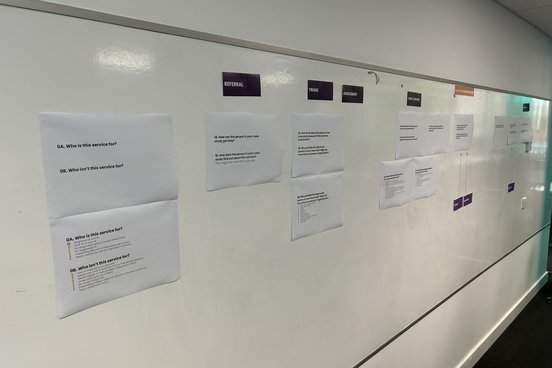
4. Creating a high-level service map
Working collaboratively, we produced a user journey from referral to discharge, capturing how residents, families, and professionals would experience the service. This map became a shared reference point for decision-making and market engagement planning.
5. Prioritising equity across SEL ICS
A consistent message across boroughs was the need for parity of access while respecting local context. Workshops enabled honest discussion about resource differences and operational realities. The emerging model balances consistency with local flexibility—ensuring all autistic adults can access a core offer while allowing place-based adaptation.
What we learnt
The need is broad, diverse and urgent
The lived-experience cases shared were not edge scenarios—they were everyday examples of people missing out on timely support. The system recognises that without early intervention, the personal, financial and societal consequences are significant.
Clarity on the Tier 2 definition unlocked progress
Defining the middle tier—between universal support and crisis care—created alignment across providers, commissioners and clinicians. Without this shared understanding, service development would have remained fragmented.
People need relational, not transactional, support
Autistic adults and their families often experience a cycle of being assessed, signposted, and then left without sustained help. The proposed Community Autism Team (CAT) emphasises continuity, trust-building, and autism-informed approaches—qualities repeatedly identified as essential.
Equity requires intentional design
Every borough wants an offer that is both fair and feasible. Designing a consistent core model—while enabling local tailoring—respects the reality of six boroughs working as one system.
Co-design strengthens commitment
By involving stakeholders early, decisions were owned collectively, not imposed. This built trust, reduced friction, and ensured the emerging model was realistic for those who would ultimately deliver it.
The outcome
The workshops resulted in a clear, collaborative foundation for SEL ICS’ new Community Autism Team:
A draft service specification aligned to strategic priorities, lived experience and system constraints.
A coherent Tier 2 offer that fills a longstanding gap for autistic adults post-diagnosis.
A shared understanding of target users, desired outcomes, scope and boundaries.
A high-level service map to guide future procurement, workforce planning and operational design.
Stronger relationships across boroughs, provider trusts and commissioning teams—building readiness for implementation.
As SEL ICS moves into the next stage, further co-production with autistic adults, development of pathways, and market engagement, the programme is starting from a position of alignment, clarity and confidence.
Most importantly, this work lays the groundwork for a service that:
Helps autistic adults live healthier, more connected, more independent lives.
Reduces avoidable crises and pressure on emergency and specialist services.
Moves SEL ICS closer to delivering on its all-age autism ambitions.
By designing collaboratively and centring autistic people’s needs, SEL ICS is building a compassionate and preventative model of community support—one that has the potential to transform experiences and outcomes for thousands of residents.
Planning a new community service or Tier 2 offer?
If you’re grappling with unmet need, fragmented pathways, or pressure on crisis services, we can help you co-design a clear, evidence-led model that works for your system and the people it serves.