Building an internal wellbeing knowledge hub: Innovation, AI and learning together
Vicky | Feb 2026
“I think an internal wellbeing knowledge hub would be super useful. One place we know where to go for all the content, articles, and presentations you’ve done over the years. It’s probably something you could have a go at creating with some help?”
This was some feedback I recently received which got me thinking. What if I could use AI tools, alongside help from the team, to design and build something simple?
Continuous development and learning by doing are two of our core values at Unboxed. One way we bring these values to life is through our innovation days. You’ve probably heard about companies like Google implementing similar initiatives. Dedicated time set aside during the year for employees to learn, develop skills, or explore ideas they’re curious about, either individually or collaboratively.
People use this time in different ways. Some develop new product or service ideas; others focus on professional development, upskilling, or learning something new. Sometimes it’s simply the space to read a work-related book that will support their growth but never quite makes it to the top of the list. The only ask is that whatever you explore, you share back with the team what you’ve been doing and learning.
Making space to invest in employee wellbeing and development
Innovation time is a long-standing practice in large tech organisations. Google’s Gmail is often cited as a product that emerged from employees’ 20% innovation time. For SMEs and startups, however, freeing up billable “project” time can feel much riskier.
But the benefits of investing in employee development and workplace wellbeing are both measurable and tangible. When leadership shows trust and a genuine willingness to invest in people’s growth, it pays off in productivity, company culture, engagement, and importantly, in the happiness and wellbeing of the people themselves.
Creating intentional space for innovation isn’t just about generating new ideas though, it’s about building a sustainable, healthy organisation.
An innovation day in practice: creating a wellbeing knowledge hub
For a while, I had been thinking it would be helpful to have all the workplace wellbeing content I’ve written or curated over the past few years, including presentations, articles, talks and calendars, in one central, easily accessible place for the team.
It felt like a ‘nice to have but probably won’t happen — I just need to better organise myself.’
That changed after a conversation with Rhian Lewis (one of our developers at Unboxed), who said:
“Oh, we should be able to explore a solution quickly. Shall we have an innovation day and see what we can do?”
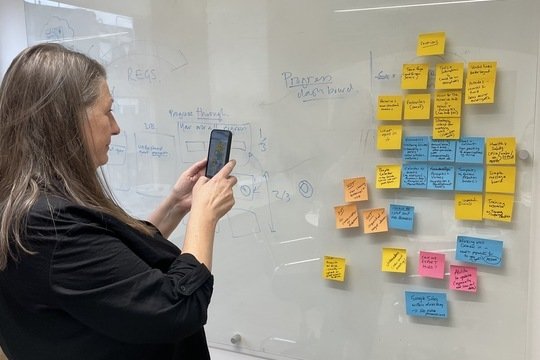
So we spent the day exploring the idea of an internal wellbeing knowledge hub. We wanted to understand whether it would be valuable for the team and how we might build something simple and scalable to test the idea.
We were trying to address two main pain points:
My own organisation, planning, and visibility of wellbeing information across the company
Resources and content living in too many places, making it harder for employees to find what’s relevant and useful
Building a no-code solution (without being technical)
Full disclosure: despite working in a digital agency, I’m not a technical person. I know the two aren’t mutually exclusive, but my interests sit firmly with humans, human behaviour, leadership, and organisational culture.
Whatever we built needed to be something I could easily maintain and continue developing over time, without feeling blocked by technical knowledge.
We didn’t really know what the outcome of the day would be. At best, we hoped for a plan.
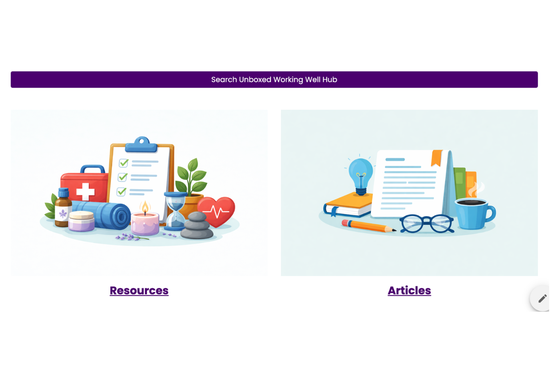
With the help of AI tools, we ended the day with a very basic MVP of what we now call the Working Well Knowledge Hub. Guided by Rhian, we used tools such as ChatGPT, Claude and Gemini to help us clarify the problem, decide on an approach, and work step by step through building something practical.
Within a couple of hours, we had created a simple, no-code prototype using Google Sites, a lightweight solution that could be tested, iterated on, and improved over time.
I’m not going to win any design awards. But going from idea to working prototype was remarkably fast. Importantly, it left me with something I can now continue to shape and develop alongside colleagues.
AI in the workplace: curiosity and overwhelm
Our innovation day aligned closely with Unboxed’s wider approach to understanding how best to use the growing number of AI tools emerging so rapidly. As a digital agency, staying curious about technology is part of who we are. Personally, though, I find the pace of AI development overwhelming. And I know I’m not alone.
Research suggests that while 56% of UK workers feel excited about AI’s potential, 61% also feel overwhelmed by how quickly it’s developing. A lack of support is often cited as one of the biggest sources of stress. And yet, the overall mood appears to be one of cautious curiosity.
For organisations thinking about adopting AI in the workplace, this tension matters.
Kind leadership in a time of rapid technological change
Kind leadership means recognising the full range of emotions people bring to work — even in technology-focused organisations.
Open, honest conversations and the right support structures are essential when introducing new tools. Without them, feelings of overwhelm can cause people to freeze, disengage, or avoid technologies that may have significant potential for good.
AI is different from many previous digital tools because of the sheer speed of its evolution. There is no clear instruction manual; only curiosity, experimentation, shared learning, and thoughtful implementation. The genie is very much out of the bottle. Like any tool, the question is not whether we use it, but how we use it in ways that align with our values and support employee wellbeing.
Learning together, safely
Spending the day experimenting with Rhian gave me a safe space to engage with tools and language I find challenging. I could learn from her skills, knowledge and curiosity at a pace that felt manageable.
This kind of peer learning is happening across Unboxed in different ways. Through collaboration and spaces like our weekly Vibez Academy, people have the opportunity to experiment with AI tools, share insights, build confidence, ask questions and learn together.
As new workplace technologies emerge, language evolves and required skill sets shift. Perhaps the real work for organisations is not simply adopting new tools, but creating the time, safety and psychological support for people to explore them thoughtfully and to adapt without negatively impacting their wellbeing.